

Preparing for War
When war came in September 1939, Taieri did not need to be invented or imagined into service. It was already there as a functioning aerodrome, with hangars and workshops. Within days of the outbreak of hostilities, the field passed from civil use into military control, becoming an active station of the Royal New Zealand Air Force almost overnight.
The transition was rapid and decisive. Although Taieri had already been selected as the future base for a Territorial squadron, no accommodation had yet been built when war was declared. That changed immediately. The Public Works Department moved in and, working at speed, constructed the core facilities required for a permanent flying station. Within six weeks, Taieri was ready to operate as a military base—an extraordinary turnaround that reflected both urgency and the advantage of a site already proven through civil aviation.
On 7 October 1939, Taieri became home to No. 1 Elementary Flying Training School, the first of four such schools established nationwide. Its task was fundamental and relentless: take young men with little or no flying experience and turn them into military pilots fit to progress to more advanced training. The work began with modest resources - initially just a single hangar - but it expanded rapidly as the tempo of training increased.

Bill Christiansen at RNZAF No 1 EFTS Taieri in 1940
(attribution unknown)
The aircraft that defined this phase of Taieri’s life was the de Havilland DH.82 Tiger Moth. Simple, light, and unforgiving of inattention, it was ideal for elementary training and utterly unsentimental. Hundreds of pilots passed through Taieri in these aircraft, performing circuits, forced landings, navigation, and formation flying over the Taieri Plain and surrounding districts. At peak periods, the valley was busy with movement: Tiger Moths climbing away in steady succession, others descending into paddocks and auxiliary fields, instructors watching closely, always measuring their student’s judgement as much as their handling skills.
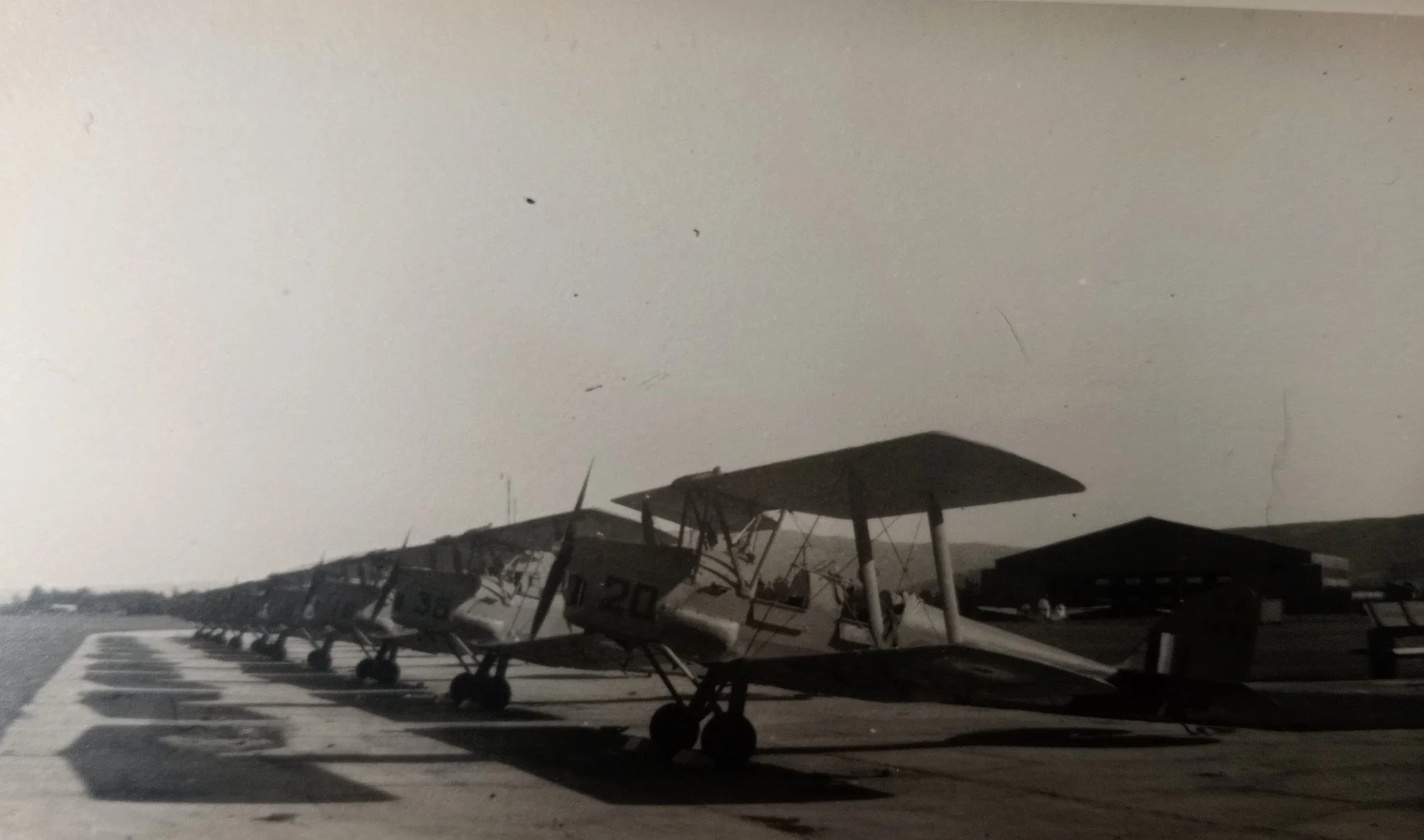
De Havilland DH-82 Tiger Moths operated by RNZAF at No 1 EFTS Taieri.
(Roger Oudemans, Facebook)
Taieri’s wartime role went beyond flying instruction alone. Maintenance units, grading schools, and initial training elements were stationed there, turning the aerodrome into a complex system rather than a single-purpose base. Command passed through experienced hands, including Squadron Leader Stedman at the station’s opening, followed by senior officers who brought with them deep instructional experience and administrative authority. By the early 1940s, Taieri was no longer simply a southern outpost; it was part of the machinery feeding aircrew into a global conflict.
That scale carried risk. Training accidents were an accepted and grim reality of wartime flying, especially at the elementary level where judgement was still forming and aircraft design offered little protection. Most days ended safely. Some did not.
On 25 August 1943, that risk converged catastrophically. Two DH Tiger Moths collided at low level while practising forced landings at the Momona Landing Field, less than 500 metres from where Dunedin International Airport stands today. Both aircraft were simulating engine failures, one approaching the field in a left hand turn, the other from the right. With no established circuit direction for the field, and limited visibility from the Tiger Moth cockpit further compromised by short Gosport speaking tubes that required instructors to lean forward to speak, the worst was set to happen.
The aircraft struck each other at approximately 500 feet, the tail torn from one aircraft, a wing from another. Both aircraft fell to the ground, killing all four men instantly.
They were: Flying Officer Robert Dallas Joseph Campbell, 27, of Mosgiel and Leading Aircraftman Brian Eric Hall, 20, of Napier Flying Officer Frank Waymouth, 34, of Wingatui and Leading Aircraftman Lewis Howard Ireland, 21, of Auckland.
For the RNZAF, the accident was recorded, investigated, and absorbed into the grim arithmetic of wartime training. For families, it was something else entirely. Robert Dallas Joseph Campbell was a husband and a father. His daughter was three years old when her father died. The consequences of that day did not end with the recovery of wreckage, or the Board of Inquiry, or the closing of files; they echoed through the following generations of all four families, shaping lives far removed from the Taieri Plain and yet permanently anchored to it.
That matters when we tell this story. Taieri as a military base was efficient, necessary, and vital to the war effort - but it was also a place where young men would die long before they reached operational theatres. The calm order of training schedules sat alongside the knowledge that not everyone would walk away from the lesson. In fact, a total of 7 fatal flying accidents, resulting in the deaths of 11 service personnel, would occur by the end of No. 1 E.F.T.S.'s existence on October 14th, 1944.
By the time the war ended, Taieri had played its part. It would remain an RNZAF station for years afterwards, but its most intense period - the years when the valley filled daily with training aircraft and the pressure to produce pilots never eased - belonged to the war. The aerodrome returned to civil use, with less activity and quieter, but forever changed.
What endured was not just infrastructure, but memory: of a place that trained pilots for a world at war, and of the individuals - known and unknown - whose lives intersected with Taieri at moments that defined everything that followed.