

Looking for a Home
Taieri didn’t begin as a neat rectangle on a map with a windsock and a gate. It began as an argument: that Dunedin and Otago deserved a real aerodrome, and that waiting politely for Wellington to notice was not a plan. In the late 1920s, the Otago Aero Club was building itself into a credible organisation with rules, officers, meetings, and membership, but without the one thing that made an aero club more than a debating society: somewhere to operate from.
By April 1928, that gap had become the central issue. When the Club confronted Minister of Defence F. J. Rolleston in Dunedin, the message coming back was bluntly practical: no aerodrome, no hangars, no workshops - no aircraft. White’s famous “stable before the horse” line wasn’t theatre. It was the reality of civil aviation policy at the time: facilities first, then assistance. The Club replied with the only leverage it had - momentum. It would find land, secure a field, and force the question back onto the Government.
The first serious hunt was for land close to town, something that could be turned into a landing ground quickly, and something the public would actually use. Various sites were considered, including reclaimed foreshore land near Andersons Bay Road, but the early frontrunner became Green Island.
In November 1928, Charles Todd stepped in on behalf of the Club and the Otago Expansion League, taking up an option over “Whitehaven Farm,” a 52-acre property bounded by the Main South Road, Brighton Road, and the Kaikorai Stream. The price - £1,000 paid to the estate of the late Alex Brown - wasn’t just a property transaction. It was a statement that Otago was done waiting for permission.
Green Island worked, but only up to a point. It gave Dunedin a place where aircraft could arrive, be welcomed, and be seen. Visiting machines began dropping in; civic leaders were taken aloft; public confidence started to shift from “flying is elsewhere” to “flying is here.” But it also exposed the hard truth that a “landing ground” and an “airport” are not the same thing. The Green Island site had serious constraints that couldn’t be ignored: drainage, surface reliability, and the question of whether it could ever serve larger commercial aircraft. By the middle of 1930 the Club was cautious about pouring money into expensive improvements without being absolutely sure the site was adequate for the future.
This was the moment that Taieri become a contender - not because Green Island failed, but because the Club’s ambition outgrew it. The Club had moved beyond wanting a paddock from which to teach people to fly. It wanted an airport worthy of a modern city: flat, expansive, and defensible as a long-term public asset. Taieri offered what Green Island could not: more than 100 acres of “dead level” land, buildings that could be converted to hangars and workshops, and clear approaches - space to grow into the future the Club kept talking about.
The thing that made the move possible was money, raised in a very grass roots way: by organising. The “Golden Wings” Art Union, run jointly with the Canterbury and Southland Aero Clubs, turned fundraising into a public event and produced an extraordinary return for those times. When the draw was held in July 1930, it was framed as Dunedin’s opportunity to secure a first-class “air port,” and as proof that the region’s aviation enthusiasts were to be taken seriously.
By August 1930 the Club could finally do what it had promised it would do back in 1928: buy the ground first, then make everything else follow. Taieri was acquired from Theo Russell for the sum of £10,000, with the financing structured so the Club could carry the cost and still build. It was a deliberate step away from the compromises of Green Island and into a site that could reasonably become Otago’s permanent aviation home.
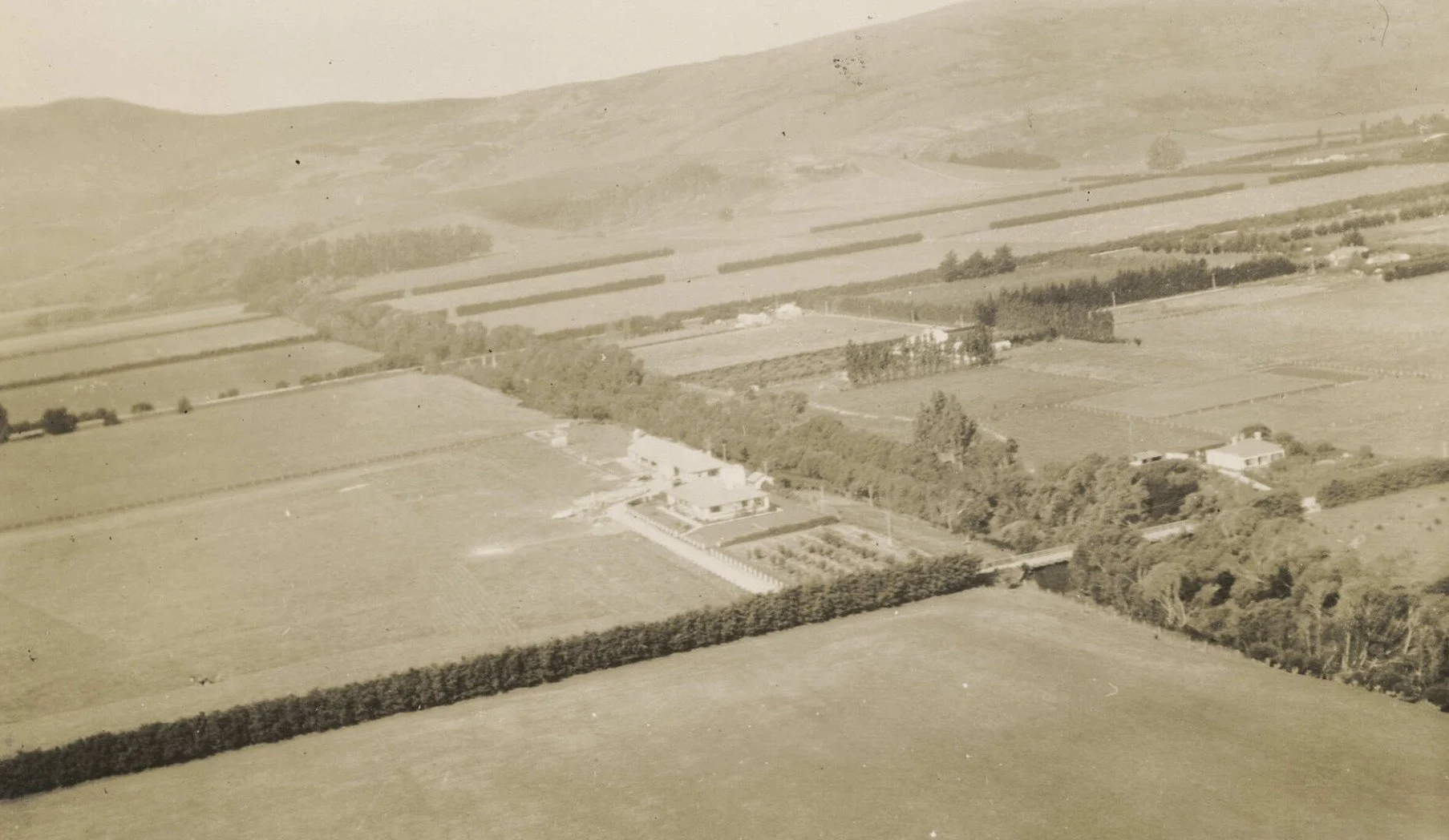
Aerial photograph of Taieri Airfield taken in 1930.
(attribution unknown)
And then, almost immediately, the story changes tone. With Taieri secured, the “we’re trying to get going” era ends and the “we are now operating” era begins. In October 1930, Flying Officer E. G. Olson arrived with a Government-loaned DH Gipsy Moth and training commenced. Within months Taieri was hosting commercial visits, club flying, and large public events - proof that the field wasn’t just a club asset but a civic one. The South Island Air Pageant in February 1931 - explicitly tied to the opening of Taieri Aerodrome and the move from Green Island - signalled that this was now a recognised aviation centre, not a hopeful dream.